
Why Your Neck Has a Natural Curve
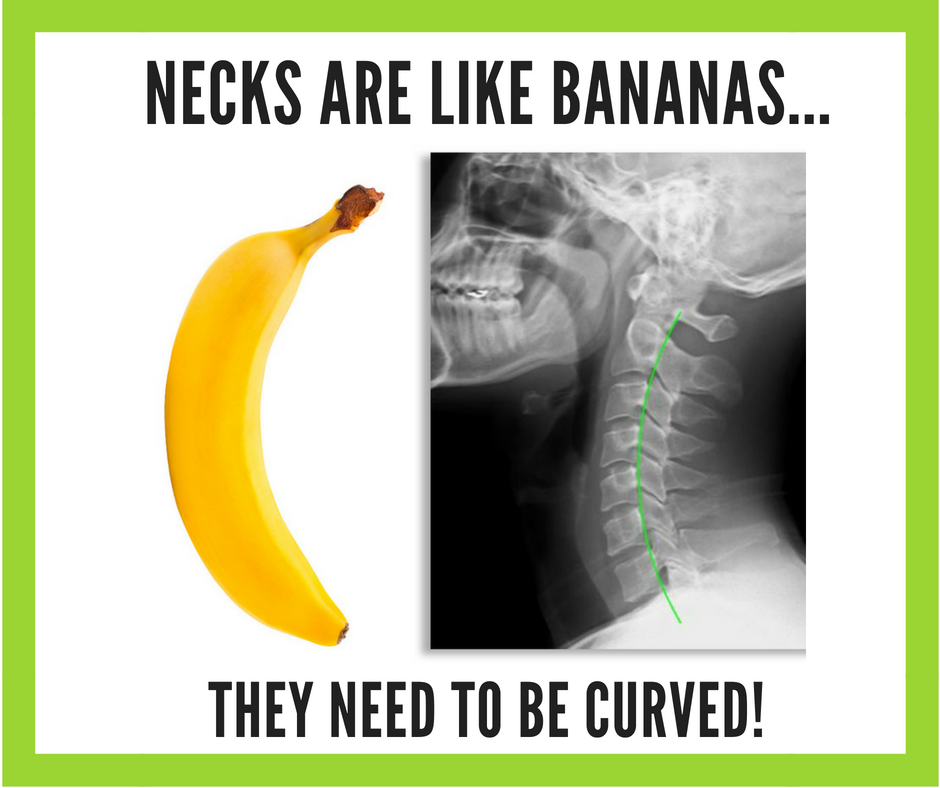
Viewed from the side, a healthy neck should have a gentle forward curve called cervical lordosis. You can think of it as a soft banana shape.
This curve forms part of the spine’s natural structure. Together with the curves of the middle and lower back, it helps balance the head over the body, distribute mechanical forces and support efficient movement.
While the precise measurement varies between individuals, a well-formed cervical curve is an important structural feature—not merely a cosmetic difference on an X-ray.
Your Head Needs a Strong, Balanced Foundation
An adult head weighs several kilograms and relies on the neck, shoulders and upper back for support.
When the head is positioned comfortably over the shoulders and the neck has an appropriate curve, the muscles and joints can share the workload more efficiently. The curve helps the cervical spine manage the forces created by gravity, movement and the weight of the head.
The neck also contains many sensory receptors that continually send movement and position information to the brain. Your nervous system uses this information to coordinate posture, balance, head movement and awareness of where your body is in space.
The cervical curve is therefore part of a much larger relationship between spinal structure, movement, muscles and nervous-system function.
What Happens When the Curve Reduces?
A reduced cervical curve is sometimes described as a straight neck, hypolordosis or loss of cervical lordosis. In some people, the curve may even reverse direction.
A straighter neck does not automatically create pain, and pain cannot be predicted from an X-ray alone. However, this does not mean alignment is unimportant.
Research led by spinal biomechanist Dr Deed Harrison has provided valuable insight into normal cervical alignment and the mechanical changes associated with altered curves. When the cervical spine moves away from its natural lordotic shape, the way forces are distributed through the vertebrae, discs, joints and supporting muscles may also change.
A reduced curve may be accompanied by forward-head posture, altered movement patterns and increased muscular demand. The body can adapt to these changes, but adaptation does not necessarily mean the spine is functioning as efficiently as it could.
This is why cervical alignment should be considered alongside movement, posture, neurological function, health history and individual goals.
Everyday Habits Can Influence Neck Alignment
Your body adapts to the positions and movements you repeat regularly.
Long periods looking down at a phone, working on a laptop or sitting with the head forward may gradually influence posture and the way the cervical spine is loaded. Previous injuries, including whiplash, may also affect alignment and movement.
Using a phone or working at a desk is not automatically harmful. The greater concern is spending long periods in one position without enough movement, variation or physical support.
Helpful habits include:
Bringing your phone closer to eye level
Positioning screens directly in front of you
Changing position throughout the day
Taking regular movement breaks
Strengthening the upper back and shoulders
Moving the neck gently through a comfortable range
Including regular whole-body activity in your routine
These habits support your neck, but they do not reveal what is happening structurally. That requires an individual assessment.
Why NorWest Uses Digital X-Rays
Posture and movement can provide useful information, but they cannot show the precise structure and alignment of the spine.
At NorWest Chiropractic, digital X-rays may be recommended when clinically appropriate. They allow us to assess the cervical curve, head position, vertebral alignment and other structural factors that cannot be seen from the outside.
An X-ray is never interpreted from one number alone. We consider the image alongside your history, posture, spinal movement, neurological findings and the demands you place on your body.
This helps us understand whether an alignment change is relevant to your function and how chiropractic care can best support you.
Supporting Better Neck Structure and Function
Chiropractic care focuses on helping the spine and nervous system function well together.
Adjustments can support movement in restricted spinal joints and provide the brain with improved information from those areas. Depending on your assessment, care may also include posture guidance, movement exercises and strategies designed to support the cervical spine.
Research involving Deed Harrison and other investigators has also explored methods of structural rehabilitation intended to improve cervical lordosis. These studies suggest that, in appropriately selected people, targeted approaches can create measurable improvements in the neck curve rather than producing only temporary changes in comfort.
Every spine is different, so care must be personalised. The aim is not to force every neck into one identical measurement. It is to work towards healthier alignment and function for that individual.
More Than a Banana Shape
The banana comparison is a simple way to explain cervical lordosis, but the importance of the neck curve goes much deeper.
Healthy neck function involves the relationship between:
Structural alignment
Spinal mobility
Head position
Muscle control
Mechanical loading
Nervous-system coordination
A person may have little discomfort while still showing significant changes in alignment. This is one reason chiropractic assessment looks beyond symptoms alone.
Regular chiropractic care, supportive movement habits and appropriate structural guidance can help your neck function more efficiently and provide a stronger foundation for an active life.
Your neck supports your head through thousands of movements every day. Looking after its alignment and movement is a positive investment in your spine, posture and brain–body connection.
Sources
Harrison DE, Harrison DD, Cailliet R, Troyanovich SJ, Janik TJ, Holland B. Cobb Method or Harrison Posterior Tangent Method: Which Is Better for Lateral Cervical Analysis? Spine. 2000;25(16):2072–2078.
https://doi.org/10.1097/00007632-200008150-00011Oakley PA, Ehsani NN, Moustafa IM, Harrison DE. Restoring Cervical Lordosis by Cervical Extension Traction Methods in the Treatment of Cervical Spine Disorders: A Systematic Review of Controlled Trials. Journal of Physical Therapy Science. 2021;33(10):784–794.
https://doi.org/10.1589/jpts.33.784